First Day in Hakama
2025年11月24日
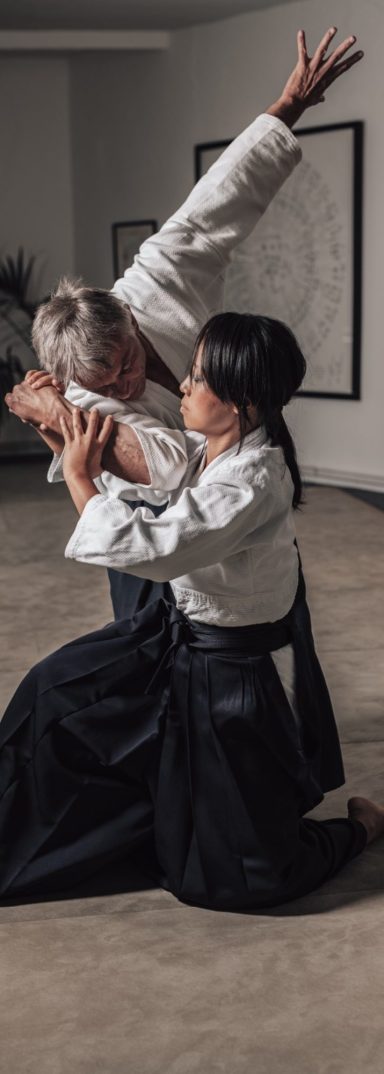
Today was the first day I wore a hakama in Aikidō training. Strictly speaking, it wasn’t my first time wearing one—mine originally comes from Iaido—but it was the first time wearing it in this context, in this particular interplay of movement, discipline, and meaning.
My motivation for taking the exam was partly a wish to reach a certain level as soon as possible, and partly a desire to avoid a particular kind of unsolicited “advice” that sometimes comes from people who wear a hakama—not necessarily because they know more or truly wish to help, but because the garment seems to lend them a sense of authority. At times, it even feels as though they speak simply because no one else is listening. Perhaps that sounds harsh, but it reflects my experience.
It reminds me of learning to express oneself in a foreign language. Your vocabulary might be at level 1 while your thoughts are already at level N. If you have learned other languages before, you progress faster, but time is still needed. Yet when someone not only tells you what to say but begins to instruct you on how to think, how does that feel? My limited vocabulary in this new “language” of Aikidō does not reflect any limitation in thought or logic. And in a dōjō—or a dance studio—the way we treat a “beginner” reveals far more than skill or hierarchy. It reveals the humanity of the place.
Returning to the garment itself: today, for the first time, I felt what its true value might be. I sensed a deeper connection to my “center,” which in Chinese I call Dān Tián. In Japanese it is written with the same two characters: 丹田 (Tanden).
In Daoist understanding, 丹 means “red” or “cinnabar,” suggesting a glowing, concentrated energy. 田 means “field,” implying not a single point but an area expanding horizontally and vertically. Together, they evoke a spherical field of energy.
A sphere has no sharp edges. It rotates. And it maintains balance not by freezing itself in place, but by continuously rediscovering equilibrium—receiving each moment’s balance by letting go of the last, which was never meant to endure.
During training, I could clearly feel the extra weight of the hakama and the additional Schwung it created in certain swift or expansive movements. It felt almost like a stage costume—adding texture, presence, a subtle flourish. I was struck by the contrast: when I dance, I prefer to feel as light as possible, almost weightless. But in Aikidō, I need to ground myself, to settle into my own weight. The hakama supports exactly that, bringing me closer to the earth, to my center.
Yet as soon as training ended, my only wish was to shed this extra layer. It was uncomfortably warm, and I confess I am not fond of folding it—even though the act is traditionally an exercise in patience and mindfulness. I prefer simply hanging it up, especially since an Iaido hakama has a firm back board that allows it to hang open and elegantly by itself.
Still, I often think of my teacher Andreas and the first time he called me over, sat me down, and quietly demonstrated how he folded a hakama—his own, in that moment. I was nowhere near taking my exam then, yet I felt profoundly grateful. That gentle gesture has stayed with me ever since.
In the end, wearing the hakama today felt like entering a new chapter—one that calls for grounding, presence, and humility. It weighed on me, warmed me, centered me, and irritated me just a little, and yet all of that felt utterly appropriate. Aikidō reveals itself through these small paradoxes: heaviness and grace, discipline and freedom, frustration and gratitude.
Perhaps a hakama is only fabric. And perhaps it is also a quiet mirror—reflecting where I stand in this practice, in my body, and in my patience. It reminds me that progress is not measured only in skill, rank, or technique, but in the way I carry myself through discomfort, ritual, and learning.
For now, I will continue walking this path—one fold, one movement, one breath at a time.