
The Axis
2025年8月31日
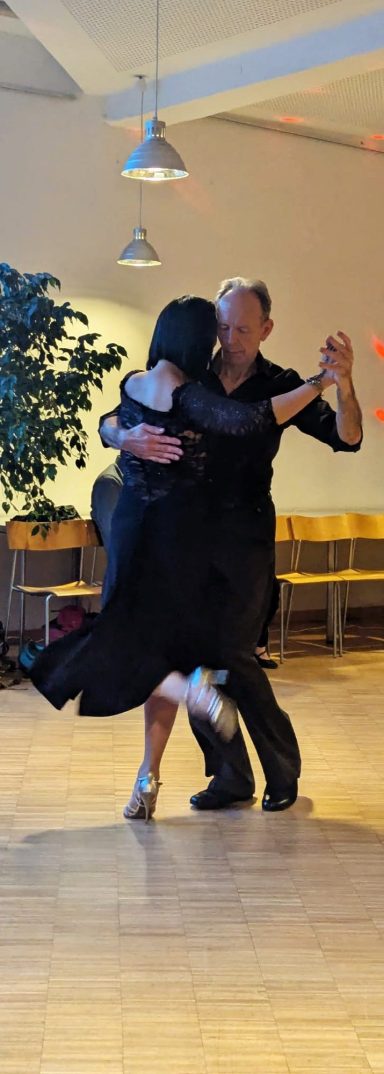
This spring, Claudia came to my milonga at the Atelierhaus on Baumstraße. It was a lively evening with many guests, and to be honest, she did not stand out to me at first. At some point she asked whether I offered private lessons. I said yes, but didn’t give the question much thought.
It was only in our first class that I realized: Claudia has been dancing tango for many years. And yet, to my surprise, she felt heavy in the embrace—despite being physically light.
This experience led me to reflect on a central theme in tango: the axis (中心线).
My Axis, Your Axis, Our Axis
My axis – independent, needing its own space and distance.
Your axis – equally independent and self-contained.
Our axis – not the simple sum of two lines, but a shared energetic field.
In this shared field, we rely on each other, yet each of us must still stand on our own. When you withdraw, I can re-center myself through internal adjustment. But in the moment of your leaving, I need time to respond.
Two Extremes and Their Consequences
1. Only in my own axis
Out of fear of being “hurt,” I might hold back and not offer any part of myself. Then I stay locked within my individual axis, and my partner cannot experience the creation of a shared axis with me.
2. Only in the shared axis
If I abandon my individuality entirely in order to build a shared axis, I overload my partner. He then carries the labor of two people. And once he steps away, I lose myself, because I no longer know how to return to my own axis.
Her Worry: “Being Too Heavy”
Many followers carry the fear of feeling “too heavy” for their partner. When I asked Claudia why she kept moving in her own independent axis, this was the first reason she gave.
My initial assumption was a kind of body-weight anxiety.
But she explained that wasn’t the case at all:
She wanted to remain an independent woman.
This thought opened something for me.
An Analogy: Sharing Household Work
Our shared axis is like dividing household chores:
If Claudia both cooks and cleans, I have two options:
Either I run after her trying to “correct” or override things,
or I sit and wait until she finishes everything.
In both cases, I cannot fully enjoy the partnership. I am either pushed into too much action or forced into passivity. And perhaps, while I sit on the sofa waiting for her to finish cooking, she is silently frustrated.
Then Claudia told me she actually dislikes cooking but loves cleaning.
And I, on the other hand, love cooking and strongly dislike cleaning.
Suddenly it became clear: we could be excellent partners.
I cook—sometimes surprising her, sometimes meeting her requests.
She cleans—freely, without me needing to think about what products or methods she prefers.
In sharing these tasks, both of us contribute to a harmonious “home,” maintaining our life together.
This is how the shared axis in tango works:
The leader carries responsibilities such as spatial awareness, navigation, and ensuring the follower’s safety and orientation.
The follower brings dedication, presence, and the willingness to share their axis.
But if one partner cannot soften into shared axis—cannot offer that trust—then the other has to take on an additional burden on top of their own role.
Trust at the Core
In the end, the question is simple:
Can I trust my partner?
And if not—does it stem from the deeper fear that I cannot fully trust myself?
A follower who aligns their energy level harmoniously with the leader dances with an entirely different quality than a follower who is constantly checking whether the leader can handle the role—or whether they themselves can keep up.
Final Reflection
Working on the axis is more than technique.
It is a mirror reflecting how we relate to closeness and distance, trust and responsibility.
Claudia showed me that “independence” and “surrender” are not opposites.
Only when my axis, your axis, and our axis are in balance does the true essence of tango emerge.